
Discover the partnership websiteLiving Atlas of Quality

 Publication:27 August 2026
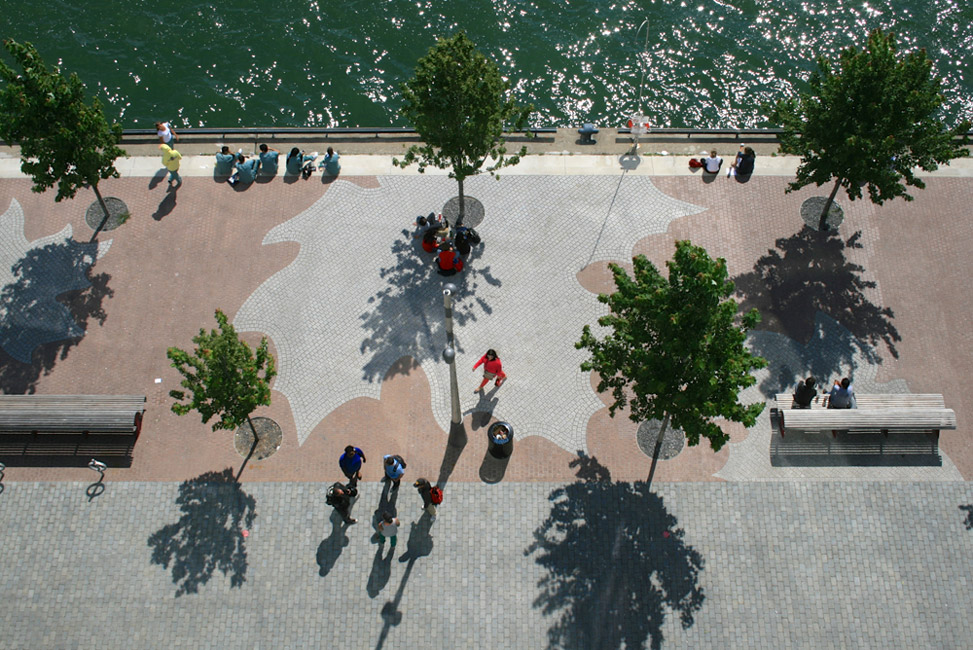
(Description from The Canadian Society of Landscape Architects) Unique to the project are high quality, custom designed paving, furniture and tree planting details inspired by the Canadian iconic maple leaf. The promenade is an example of a public open space delivered in conjunction with public works improvements, including dock wall reinforcement. West 8 + DTAH closely worked with the contractors on site, collaborating on pavement mock-ups and fabrication of benches and lights. East Bayfront Water's Edge Promenade is a successful precedent project for future development on Toronto's waterfront. Source: https://www.csla-aapc.ca/awards-atlas/east-bayfront-waters-edge-promenade
| Location | Canada|Ontario|Toronto |
| Typologies | Landscape urban design and planning|Public spaces, streets and squares |
2014 Visualisation et exploration du front de mer réaménagé de Toronto_TMU_#29
This study was presented at the 2026 Learning & Teaching Conference at Toronto Metropolitan University. The study builds on the works of Canadian artist Larissa Fassler and Danish architect and planner Jan Gehl, who document the uses of public spaces. It presents approaches the author developed in order for her and her research team to analyze and understand the usages of public spaces. It focuses on two sets of locations: Love Park - a site which replaced a vehicular infrastructure formerly hosting a Gardiner Expressway off-ramp - and the East Bayfront Precinct - 23 waterfront hectares bookended by Sugar Beach and Parliament Slip that have been rapidly transforming into a mixed-use area. Specifically, it reviews their planning as well as their evolution and examines how such locations are being revitalized and transformed with the creation of several award-winning projects. Through fieldwork, observational studies and maps, this presentation visualizes the use of public space and showcases ways to synthesize activities they host. This is done via the development and application of methodological innovations that can help examine open urban areas. This work is related to the overall conference’s theme and bridges the classroom with the community in multiple ways. First, it presents various means to document and understand how public spaces are used. Second, it engages and mentors graduate research assistants that have contributed to this study also by inviting them to present related findings in undergraduate classrooms. Further, the replicability and scaling-up properties of the methodological approaches featured in this presentation shed light on segments of Toronto’s revitalized waterfront and can help open new doors for researchers and students in their own research. Conference presentation by Leila M. Farah. Contributors: Nicole Li, James Goodeve, Ryan Bang Ma, Olivia Nunn and Hunter Kauremszky.
 Plan directeur de 2005 de East Bayfront Precinct_TMU_#9
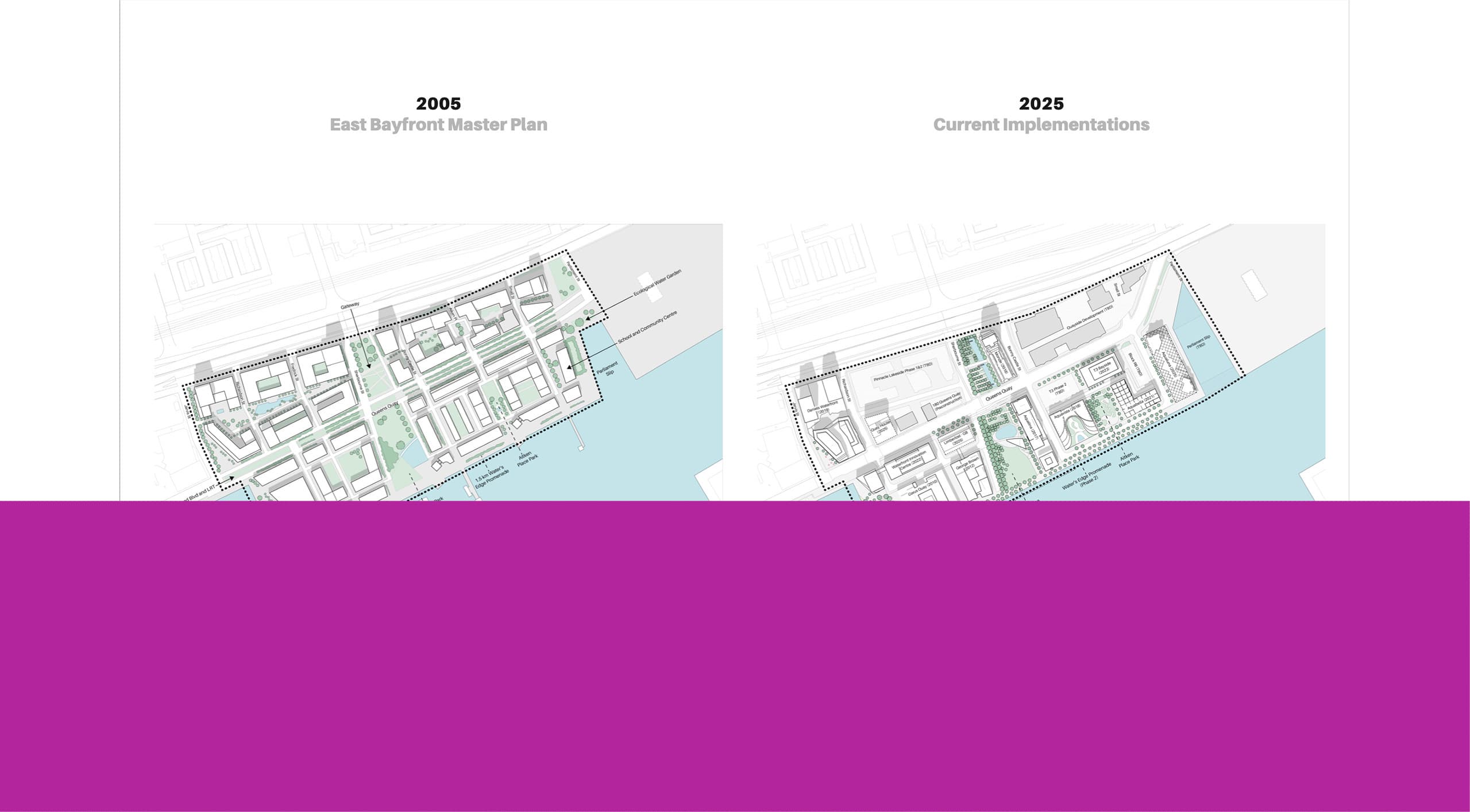
The East Bayfront Precinct case study investigates the evolution of an area located along the Toronto Waterfront, between Lower Jarvis and Parliament Streets. This study revisits the 2005 master plan, surveys the current setting twenty years later, reviews its evolution, and examines how the area has been and continues to be revitalized and transformed with the creation of several award-winning projects. This Work was displayed as part of Stories in the Making: Transforming the Toronto Waterfront, an exhibition at the Paul H. Cocker Gallery in the Department of Architectural Science at TMU, co-curated by Terri Peters, Yaxin Jiang, Leila Farah, and Marco L. Polo. This exhibition was part of the 2025 Annual Convention of the SSHRC-funded partnership titled Quality in Canada's Built Environment. A description of the exhibition was co-written by the co-curators and disseminated on the Department of Architectural Science's April newsletter as well as its website. See https://www.torontomu.ca/architectural-science/stories-events/2025/04/stories-in-the-making--transforming-the-toronto-waterfront/. In addition, part of this study was included in the TMU poster titled: Let’s all Meet by the Lake. Inclusivity and Well-Being on Toronto’s Waterfront was displayed at the QCBE 2025 Toronto Convention at the University of Toronto.
